Tennis Elbow: Why Rest Alone Rarely Fixes It
Updated: 3 days ago
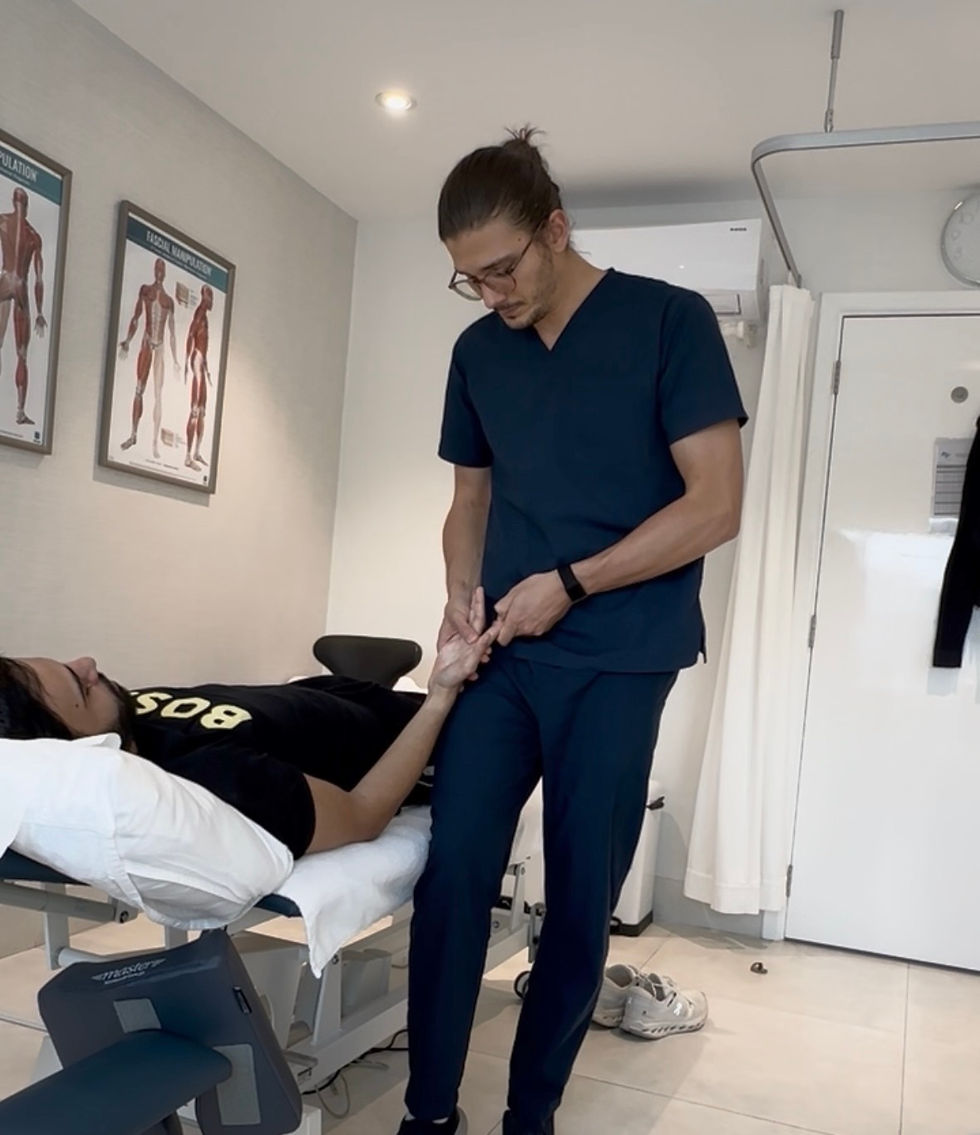
Tennis elbow — pain on the outer elbow that flares with gripping or lifting — is one of the most common musculoskeletal complaints, and one people often try to rest away without lasting success.
The pain sits where the forearm tendons meet the elbow, but the fascia of the forearm runs the whole length of the arm, from wrist to shoulder. When that line is tight or overloaded — often from repetitive work, phone use, or an unrelated shoulder issue — the elbow ends up carrying tension it was never meant to hold alone.
The nervous system keeps the area sensitive too. A tendon that's been irritated for months can stay protective, firing pain signals at loads it used to handle easily. Rest quietens it briefly, but the moment load returns, so does the pain, because the underlying capacity was never rebuilt.
This is why gradual, progressive loading — not just rest — is central to recovery. Rehabilitation restores the forearm's tolerance, releases fascial restriction up the arm, and addresses contributing factors at the wrist and shoulder.
The Arm Works from the Trunk Outward
Every time you grip, lift or type, force travels along a chain that starts at the trunk. The shoulder blade forms the base, the shoulder positions the arm, and the elbow, wrist and hand carry out the fine work. When the base is stable and well positioned, the forearm muscles only need to do their share. When it isn't, the smaller muscles further down the chain compensate by working harder and longer than they should.
The muscles that extend the wrist, the ones that attach at the painful outer elbow, are particularly exposed to this. They are small, they work during almost every gripping task, and they are often the first to absorb extra demand when the larger muscles around the shoulder aren't contributing fully.
Opening the Chest
Long hours at a desk, driving and phone use tend to pull the body into the same shape: shoulders rolled forward, upper back rounded, chest muscles shortened. In this position the arm sits turned inward, and to work a keyboard, mouse or phone from there, the forearm and wrist have to twist and hold themselves in awkward angles for hours.
From a fascial perspective, the connection is more direct. Anatomical models of the arm's fascial continuity describe a line running from the upper back and shoulder, down the outer upper arm, into the very forearm muscles that attach at the painful point of the elbow. Tension held at the shoulder end of that line can add to the load felt at the elbow end.
Opening the chest means restoring the ability of the upper back to extend and the chest muscles to lengthen, so the shoulders can rest in a more neutral position. Typical approaches include releasing the chest muscles and the fascia around the front of the shoulder, extension exercises for the upper back over a rolled towel or foam roller, rotation exercises in side-lying, and simple doorway stretches for the chest.
It's worth being clear about what this does and doesn't mean. Posture on its own is rarely the cause of tennis elbow, and there's no single correct way to sit. The goal is not to hold a rigid upright position all day, but to give the shoulder and upper back enough mobility that the arm has options, so the forearm isn't forced into the same strained position for hours at a time.
Improving Scapular Control
The shoulder blade, or scapula, is the platform the entire arm operates from. It needs to glide, rotate and hold steady as the arm moves. Several studies have found that people with tennis elbow often have weaker shoulder and shoulder blade muscles on the painful side, particularly the lower trapezius and the muscles that rotate the shoulder outward. Whether this weakness contributes to the problem or develops alongside it isn't fully settled, but the practical implication is similar: a less stable base places more demand on the muscles further down the arm.
You can often feel this in daily life. Lifting a kettle or carrying shopping with the shoulder hunched and the shoulder blade poorly supported tends to make the grip clench harder, and the forearm tires faster. With the shoulder blade set and supported, the same task often feels lighter at the elbow.
Scapular control training usually starts with learning to feel and position the shoulder blade, then progresses to strengthening: wall slides, band exercises that rotate the shoulder outward, rows focused on drawing the shoulder blade back and down, and exercises lying face-down that target the lower trapezius. Later, this control is integrated into the tasks that provoke symptoms, such as gripping, carrying and lifting, so that the improved shoulder base shows up where it's needed.
Putting It Together
Opening the chest gives the shoulder room to position the arm well. Scapular control gives the arm a stable base to work from. Neither replaces direct, progressive loading of the forearm tendons, which remains the core of recovery, but together they reduce the demand the elbow is asked to absorb in the first place. Combined with treatment of fascial restriction along the arm, this addresses the whole chain rather than only the point of pain.
A personalized assessment finds what's actually overloading the elbow. We offer home physiotherapy and rehabilitation for elbow and musculoskeletal pain across Dubai — physio Dubai, physiotherapy in Dubai.


Comments